Browse products by medical specialities area or therapies
Product by Therapies
Product by Type
Product by Therapies
Product by Type
Arthroplasty
Product by Therapies
Product by Type
Sports Medicine
Product by Therapies
Knee Portfolio - ACL /PCL Reconstruction
Knee Portfolio - Meniscus Repair
Shoulder Portfolio - Bankart/Slap Repair
Shoulder Portfolio - Rotator Cuff Repair
Product by Type
Why Choose a Red Light Therapy Pod for Your Business?
The wellness economy is expanding, but customers are becoming more selective. The Global Wellness Institute’s 2024 Global Wellness Economy Monitor valued the sector at approximately $6.3 trillion in 2023. It projects growth toward nearly $9 trillion by 2028. These figures suggest strong commercial interest, not guaranteed success.
A Red Light Therapy Pod can create a visible, structured wellness experience. Clients enter a private pod, follow a timed session, and leave with a simple routine. That clarity may support repeat visits and easier staff training. McKinsey’s 2024 Future of Wellness research also highlights growing consumer interest in appearance, healthy aging, and personalized services. A pod can fit these preferences without requiring complicated treatment menus.
Still, equipment alone does not build trust. Evidence for red and near-infrared light continues to develop across different uses, devices, and wavelengths. Businesses should avoid promising disease treatment or dramatic results. The American Academy of Dermatology recommends discussing realistic expectations and checking product information carefully. Sensible operators record session times, explain eye protection, and screen for relevant customer concerns.
Details matter.
Before investing, owners should compare irradiance data, maintenance costs, cleaning procedures, warranty coverage, and room utilization. Grand View Research and other market analysts report continued expansion in light-based wellness technologies, yet market forecasts are not business plans. A poorly positioned pod may become an expensive room ornament. A well-managed one can strengthen customer retention, diversify revenue, and make the brand feel more professional. The opportunity is credible, but thoughtful execution remains the real advantage.
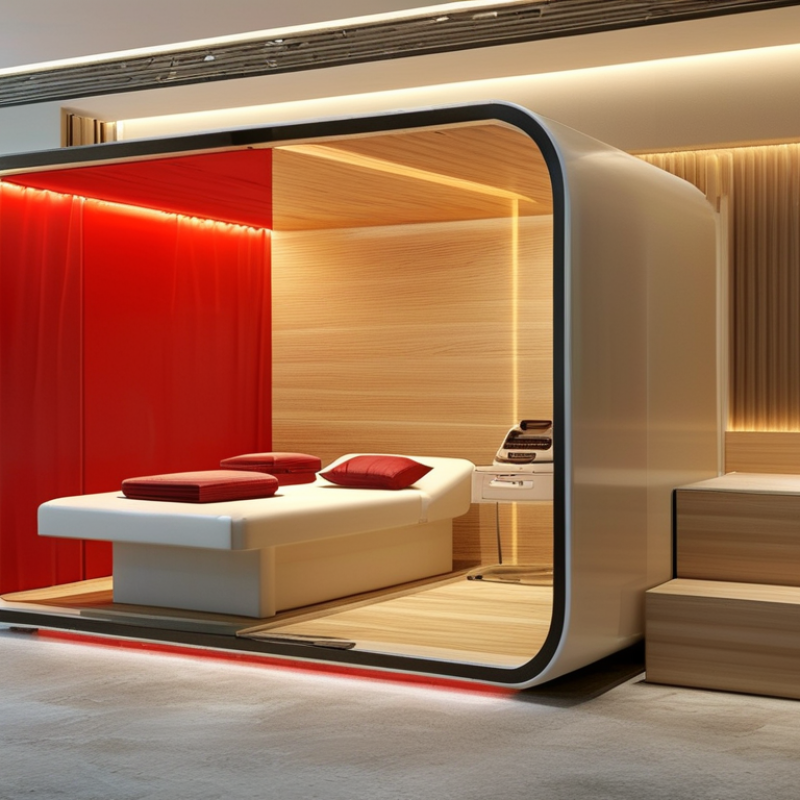
A red light therapy pod is a booth fitted with LED panels. It delivers red and near-infrared wavelengths across much of the body. Common ranges include 630–660 nanometers and 810–850 nanometers. These wavelengths may interact with cellular energy processes, including mitochondrial activity. However, the category is not perfectly standardized. Device strength, treatment distance, session length, and skin exposure can differ widely.
For a business, a pod can create a private, repeatable customer experience. Clients enter, follow eye-protection guidance, and complete a timed session without hands-on treatment. That workflow may support predictable scheduling and easier staff training. The Global Wellness Institute’s 2024 Global Wellness Economy Monitor reported a wellness economy value of 6.3 trillion dollars in 2023. It projects growth to 9 trillion dollars by 2028. This signals commercial interest, not proof that every pod delivers equal results. Owners should separate market demand from clinical evidence.
Tips: Ask for irradiance measurements, wavelength ranges, and independent safety testing. Review maintenance needs before purchasing. Track session attendance, customer feedback, and reported comfort. Avoid promising disease treatment or guaranteed outcomes. Clear records build trust.
A practical concern remains. Bright LEDs, heat, noise, and limited accessibility can affect satisfaction. Test the pod personally. Then ask whether real customers can use it comfortably.
Red light therapy pods use low-intensity red and near-infrared light to support photobiomodulation. Their LEDs commonly operate between red 630–660 nanometers and near-infrared 810–850 nanometers. These wavelengths can reach different tissue depths.
Light interacts with mitochondria, especially cytochrome c oxidase. This process may influence cellular energy production, circulation, and inflammatory responses.
A 2023 review in Photobiomodulation, Photomedicine, and Laser Surgery reported potential benefits for tissue repair and pain management. However, outcomes depend on wavelength, dose, distance, and session time.
The technology is promising, but it is not magic.
For a business, a pod creates a controlled space with consistent positioning and timed exposure. That structure can make staff training easier and customer sessions more repeatable.
Grand View Research valued the global red light therapy market at approximately 1.3 billion dollars in 2023, reflecting growing commercial interest. Still, market growth does not prove every treatment claim.
Operators should document irradiance, clean contact surfaces, inspect LED panels, and provide clear usage instructions. Eye protection may be appropriate for certain devices or users.
A rushed session can weaken consistency. Individual response also varies, so businesses should avoid guaranteed medical results and encourage professional advice when customers report unusual symptoms.
A red light therapy pod can give a wellness business a structured, private service. Clients enter a quiet pod, wear protective eyewear, and follow a timed session. The experience feels more specialized than a basic lamp. That difference may support premium pricing and repeat visits. The Global Wellness Institute valued the global wellness economy at $5.6 trillion in 2022. It projects growth to $8.5 trillion by 2027. Demand exists, but equipment alone will not create loyalty.
For owners, a pod can use limited floor space efficiently. It may also support membership packages, introductory sessions, and cross-selling with recovery services. The International Spa Association reported $21.3 billion in U.S. spa revenue during 2023, with about 178 million visits. These figures show strong consumer activity, not guaranteed success. Research on photobiomodulation suggests possible benefits for skin appearance, temporary soreness, and cellular processes. Results vary by wavelength, dose, treatment schedule, and individual health. Honest consultation matters. A confident sales claim can quickly become a credibility problem.
Tips: Record session times, client feedback, and repeat-booking rates. Explain that outcomes differ. Train staff to discuss contraindications and refer medical questions to qualified clinicians. Keep the pod clean, ventilated, and easy to access. Test a small membership offer before making a large investment. The numbers may look promising, yet underused equipment remains an expensive decoration.
Key Benefits for Business Owners and Clients
Red and near-infrared wavelengths shown here are commonly studied in photobiomodulation research. A pod that provides consistent light exposure can help businesses create a standardized, time-efficient wellness service while giving clients a convenient and repeatable experience.
The wavelengths are presented as reference points, not as a ranking of effectiveness. Actual results depend on factors such as irradiance, treatment distance, exposure time, skin type, and individual health conditions.
Reference: peer-reviewed photobiomodulation research commonly examines visible red wavelengths around 630–660 nm and near-infrared wavelengths around 810–850 nm, including work published in AIMS in Biophysics and Photomedicine and Laser Surgery.
Why Choose a Red Light Therapy Pod for Your Business?
A red light therapy pod can serve several business models. Fitness clubs may offer short sessions after strength training. Spas can add private recovery appointments. Hotels can create quiet wellness spaces for travelers. Sports facilities may attract athletes seeking non-invasive recovery routines. Corporate wellness centers could use pods during scheduled breaks. These applications match a growing market. The Global Wellness Institute reported that the wellness economy reached $6.3 trillion in 2023. McKinsey also estimated the United States wellness market at more than $480 billion annually. However, customer interest does not guarantee repeat visits. The experience must feel comfortable, clean, and professionally managed.
Target groups should be selected carefully. Fitness members often value convenience and measurable routines. Beauty clients may prefer relaxation and skin-focused services. Older adults may appreciate gentle, low-impact sessions, subject to professional screening. Businesses should avoid promising disease treatment or guaranteed results. Photobiomodulation research remains developing, and outcomes can vary. That matters. Trust grows through honest explanations, informed consent, and accurate session records.
Tips: Start with a small pilot program. Track bookings, repeat visits, session duration, and customer feedback. Train staff to explain realistic expectations. Keep protective eyewear, cleaning procedures, and contraindication checks visible. Review the data after eight weeks. A pod may look impressive, but utilization decides its value. One weak point is often overlooked: customers may enjoy the session but dislike complicated booking. Make access simple, then improve the offer from real user behavior.
Why Choose a Red Light Therapy Pod for Your Business?
Factors to Consider Before Investing in a Therapy Pod
Before investing, examine the treatment claims and supporting evidence. Red light therapy may support certain wellness goals, but results vary by wavelength, dose, and individual condition. A responsible operator should explain these limits clearly. It is not a replacement for medical diagnosis or emergency care. Ask suppliers for independent testing, irradiance data, treatment timers, and cleaning guidance. Vague promises deserve caution.
The room matters as much as the device. Measure door width, ceiling height, electrical capacity, and ventilation. A pod can become uncomfortable when heat, noise, or restricted movement are ignored. Consider privacy, accessibility, sanitation, and emergency access. Staff need practical training, not just a quick demonstration. Create protocols for screening, session length, eye protection, and incident reporting. Check local regulations, insurance requirements, and professional advice before opening.
Model the business honestly. Include installation, maintenance, replacement parts, energy use, training, and downtime. Estimate realistic bookings instead of ideal occupancy. Ask whether clients will return after the novelty fades. A small pilot may reveal more than a confident sales forecast. Track comfort, repeat visits, cancellations, and reported concerns. I would not promise dramatic results. Some customers may notice little change. That possibility should shape consent forms, pricing, and marketing language. Review those records every month.
| Business Factor | Typical Reference Range or Requirement | Why It Matters for a Therapy Business | What to Check Before Investing | Priority |
|---|---|---|---|---|
| Treatment Wavelengths | Red light: approximately 620–700 nm Near-infrared light: approximately 700–1,100 nm | Different wavelengths interact with tissue at different depths. A combination of visible red and near-infrared light can support a broader treatment offering. | Request the exact wavelength specification, tolerance range, and independent test documentation. Avoid relying only on terms such as “full spectrum” or “medical grade.” | High |
| Irradiance | Common commercial device specifications: approximately 10–50 mW/cm² at the treatment surface | Irradiance affects the time required to deliver a stated light dose. Higher output does not automatically mean better results, because dose and user comfort also matter. | Confirm whether the measurement is taken at the user’s body position, and ask for test conditions, measurement distance, and accuracy tolerance. | High |
| Session Dose and Duration | Many protocols use approximately 5–20 minutes per session; dose depends on irradiance and time | Short, repeatable sessions can improve appointment scheduling and daily room utilization while helping staff maintain consistent procedures. | Use the formula: dose in J/cm² = irradiance in W/cm² × time in seconds. Establish a documented protocol rather than changing settings informally. | High |
| Treatment Capacity | One client per pod per session; actual throughput depends on session length, cleaning, turnover, and operating hours | A pod can create a dedicated service line, but revenue potential depends on how many completed sessions can be delivered safely each day. | Calculate realistic capacity using: operating hours ÷ total appointment cycle time. Include consultation, changing, cleaning, and payment time. | High |
| Space and Installation | Allow the equipment footprint plus user access, ventilation clearance, staff circulation, and emergency egress space | A pod may require more floor area than flat light panels, but an enclosed layout can provide privacy and a more structured client experience. | Measure the complete installation area, door widths, ceiling height, floor loading, accessibility routes, and local fire-safety requirements before ordering. | High |
| Electrical Requirements | Many systems use standard commercial electrical service, but voltage, amperage, and circuit requirements vary by model | Electrical compatibility affects installation cost, downtime risk, and whether the pod can be placed in the intended treatment room. | Obtain the equipment nameplate rating and installation manual. Have a qualified electrician verify circuit capacity, grounding, plug type, and applicable codes. | High |
| Safety Controls | Look for timed shutoff, emergency stop, eye-protection guidance, temperature monitoring, and clear operating instructions | Standardized controls reduce operator error and help staff deliver consistent sessions across different clients and shifts. | Review contraindications, medication-related photosensitivity warnings, heat management, electrical safety certification, and the procedure for reporting adverse events. | High |
| Client Comfort | Evaluate temperature, noise, access, ventilation, interior dimensions, and the ability to stop a session easily | Comfort can influence repeat visits, reviews, referrals, and the likelihood that clients complete the recommended service schedule. | Arrange a hands-on demonstration. Test entry and exit, brightness, heat buildup, fan noise, controls, and comfort for different body sizes. | High |
| Cleaning and Infection Control | Clean and disinfect all client-contact surfaces between sessions according to product and equipment instructions | A clear turnover process protects clients, supports staff training, and reduces service delays during busy periods. | Confirm which surfaces tolerate approved disinfectants, whether removable liners are available, and how long the cleaning process takes between appointments. | High |
| Maintenance and Serviceability | LED service life is commonly rated in the tens of thousands of operating hours; other components may require earlier service | Planned maintenance helps preserve output consistency and reduces unexpected cancellations caused by equipment downtime. | Ask for warranty duration, response time, replacement-part availability, calibration procedures, software support, and the cost of routine service. | Medium |
| Energy Consumption | Operating cost depends on input power, session length, local electricity price, and standby consumption | Electricity is usually only one part of operating cost, but it should be included in the contribution margin and sustainability review. | Use: energy per session in kWh = power in kW × operating hours. Request measured input power rather than estimating from LED count alone. | Medium |
| Regulatory Positioning | Requirements vary by country, region, intended use, and marketing claims | A device’s regulatory classification and permitted claims affect advertising, staff training, consent forms, and potential liability. | Verify local rules with the relevant authority or qualified compliance professional. Keep marketing focused on permitted wellness or cosmetic claims unless authorized otherwise. | High |
| Staff Training | Training should cover screening, contraindications, settings, client communication, cleaning, emergency procedures, and documentation | Consistent training improves service quality and reduces avoidable mistakes when multiple employees operate the pod. | Request an operator manual and formal training materials. Create a checklist for intake, session setup, monitoring, completion, and incident reporting. | High |
| Return on Investment | Model conservative, expected, and optimistic utilization scenarios rather than relying on maximum capacity | Profitability depends on utilization, pricing, labor, rent, consumables, financing, maintenance, and customer retention—not only on the equipment price. | Estimate payback period using: total investment ÷ monthly contribution margin. Include installation, training, room preparation, finance costs, and downtime. | High |
| Customer Experience and Differentiation | Consider privacy, booking convenience, session consistency, educational materials, and integration with existing services | A pod can support a premium, private, and repeatable experience when it is integrated into a clear customer journey. | Define the target customer, service package, booking flow, onboarding message, follow-up process, and measurable outcomes that can be communicated responsibly. | Medium |
Reference note: The ranges above are general industry planning references, not universal specifications. Confirm the exact device performance, safety documentation, regulatory status, installation requirements, and operating costs for the equipment under consideration before purchase.